Software
As part of my research work, I'm developing a Smoothed Particle Hydrodynamics (SPH) software using the Julia programming language.
The software is designed for geotechnical engineering analysis using the SPH method, and is currently capable of:
Simulating elastoplastic materials (soils, soil-like or metals) and fluids (Newtonian or non-Newtonian)
Solving soil-fluid interaction problems
Solving soil-structure interaction problems
Solving mechanically uncoupled PDEs (e.g., heat conduction, consolidation, seepage, etc.)
The software is under active development and several new features are being added for solving a wide range of multiphysics problems.
See below for some test cases of the SPH software.
Internal erosion induced instability of coal ash ponds
Analysis of internal erosion induced instability of a coal ash pond using a five-phase, single-layer SPH model.
The first video shows the increase in porosity as the fly ash gets eroded by seepage. Erosion of the hydraulically deposited lagoon ash complete in approximately five years physical time. The second video shows the failure of the ash pond structure caused by low shear strength of the lagoon ash using the accumulated deviatoric plastic strain in the material.
Reference: Mhaski & Ramana (2024)
Density-dependent solute transport in three-phase porous media
Mathematical model developed for describing coupled flow-deformation-solute transport in three-phase porous media. Videos show the solute (contaminant) concentration variation with time in a uniform flow field without and with adsorption.
Reference: Mhaski & Ramana (2024)
Risk assessment of municipal solid waste (MSW) dumps
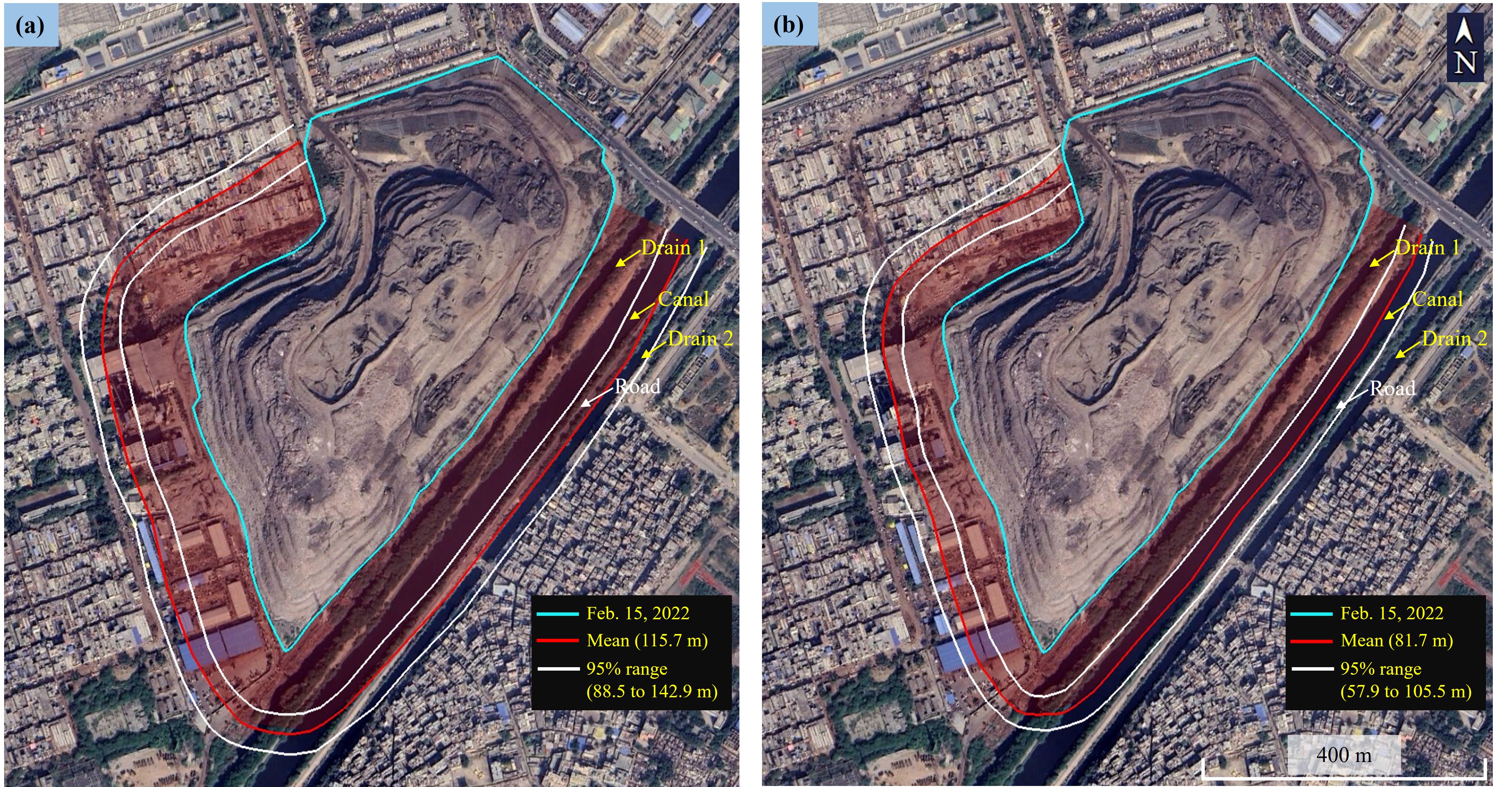
Analysis of MSW dumpsite instability considering spatial variability of material properties using two-phase SPH model. Spatial variability of MSW properties is characterized based on the analysis of MSW data reported from 28 countries. The uncertainty related to the material properties is included in the runout analysis using the random field theory in a Monte Carlo simulation framework.
The image below shows the regions susceptible to mass flow failure around the Ghazipur dumpsite in Delhi under the scenarios of controlled and uncontrolled surface infiltration.
Reference: Mhaski & Ramana (2023)
Slope stability analysis
Stability analysis of a saturated soil slope under steady-state seepage conditions. Video shows the displacement of the downstream slope obtained by SPH along with the limit equilibrium slip circle. Soil and water are modelled by a single set of SPH particles.
Reference: Bui & Fukagawa (2013)
Core overtopping in a rockfill embankment
Displacement of soil at the downstream toe of a model rockfill embankment due to increased flow rate after the clay core is overtopped. Soil and water modelled by different sets of SPH particles.
Reference: Korzani et al. (2018)
Hydraulic heave
Hydraulic heave in model excavation pit. Soil and water modelled by different sets of SPH particles.
Reference: Korzani et al. (2018)
2D granular column collapse
Collapse and flow of granular material under gravity initiated by removing support on the right-hand side.
Reference: Nguyen et al. (2017)
3D granular column collapse
Collapse and flow of a cylindrical column of granular material under gravity.
Collision of elastic rings
Collision of elastic rubber rings moving towards each other. Video shows the velocity magnitude normalized by the numerical sound speed.
Reference: Monaghan (2000)
Yield under tension
Yielding of a rectangular bar under tension using the von Mises material model. Video shows the development of the equivalent deviatoric plastic strain.
Reference: Gray et al. (2001)
Fluid dambreak
2D dambreak simulation over a dry bed using the delta SPH model. Video shows the fluid pressure normalized by the initial hydrostatic pressure.
Reference: Valizadeh & Monaghan (2015)
Heat conduction
Comparison of the analytical steady-state solution (left) and the transient to steady-state SPH solution (right) for the temperature distribution in a square plate heated at the bottom end, while maintaining a constant temperatures at the three other ends.
Reference: Filho (2019)
One-dimensional consolidation equation
Where is the excess pore-water pressure, and is the coeffcient of consolidation.
The above one-dimensional consolidation equation is numerically solved using a 1D SPH model. Video shows the comparison of the SPH and Terzaghi's solution, at various non-dimensonal time factor values.
Variable resolution SPH discretization
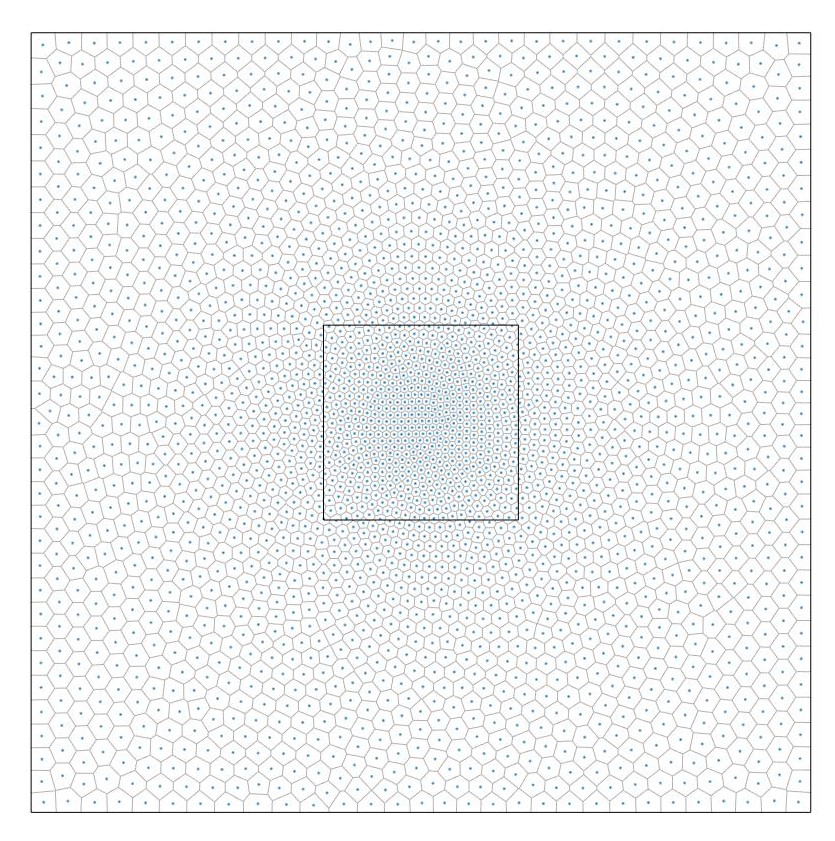
Weighted Voronoi tessellation and Llyod's algorithm for initializing particles at variable spatial resolutions.
Spatial variability modelling using Random Field Theory
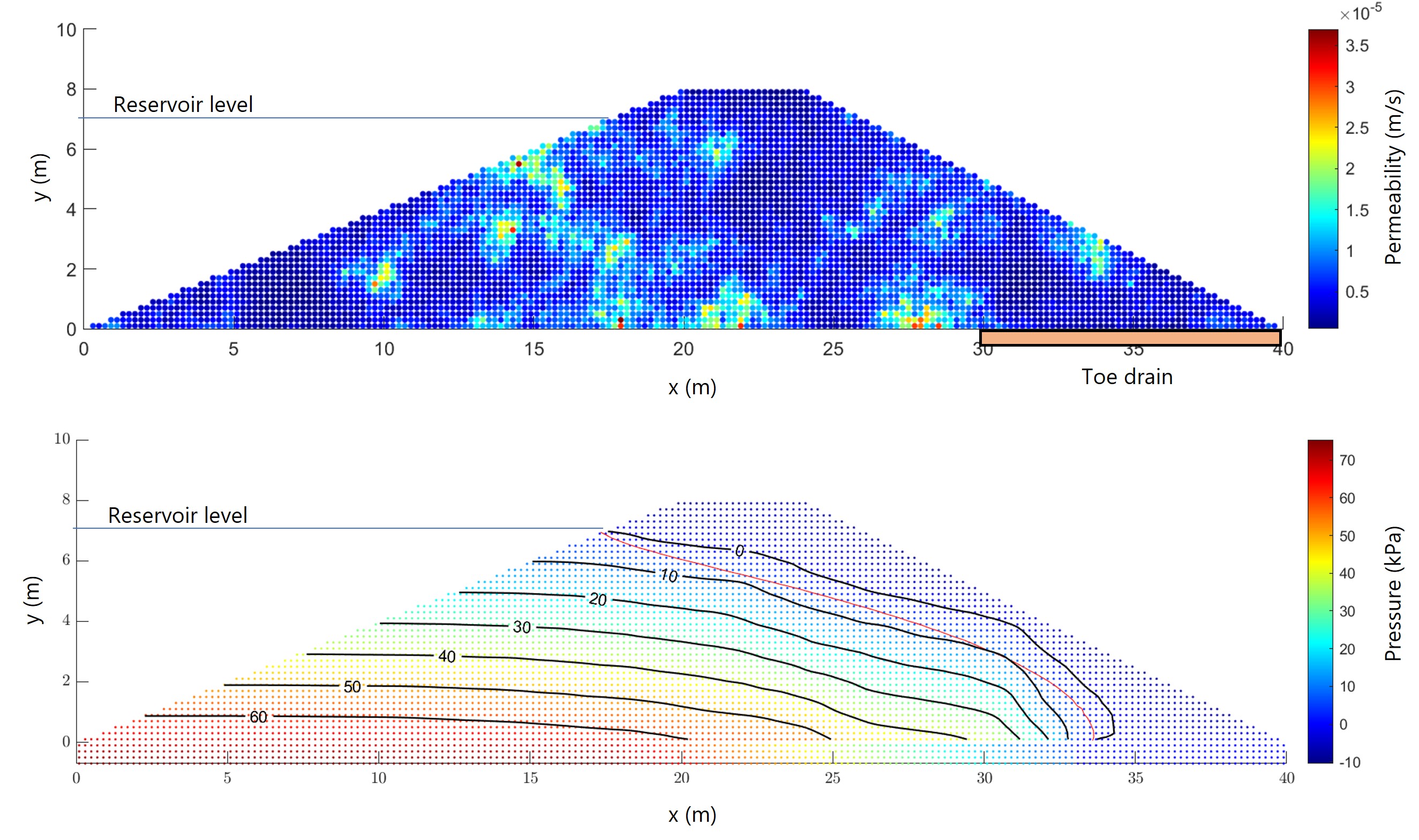
Seepage analysis using 3-phase (soil, water, air) model with spatially variable soil permeability.
Website built with Franklin.jl and the Julia programming language.